P.Oxy
Welcome
Introduction
The Site
Excavations and Finds
Daily Life
After Grenfell & Hunt
A Millenium of Documents
Scribes and Scholars
Material Culture
Email
Copyright
P.Oxy. Links page |
Oxyrhynchus:
A City and its Texts, Virtual Exhibition: A
Millenium of Documents
Receipt for taxes in gold coin: April-May, AD 624
|
This item dates from a period when Egypt was occupied by the Persians,
and is a receipt addressed to one Marinus for the payment of a large quantity
of gold coin, perhaps £500,000 at todays prices, in part-payment
of the taxes for one year levied on Oxyrhynchus and a smaller neighbouring
town.
This is one of the very latest dated Greek texts to survive from
Oxyrhynchus. Around twenty years later, it is conjectured that the
city was attacked and sacked by the invading Arab forces.
At any rate, the collection contains no texts, whether Greek or Arabic,
from the next two hundred years, suggesting that Oxyrhynchus became
a ghost town until its rebirth as the Islamic town of Bahnasa at the
end of the ninth century.
The Oxyrhynchus Papyri vol.LV no.3797 |
Report of high court proceedings: mid-fourth century AD
|
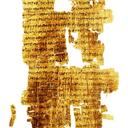
This handsomely-written sheet, lacking its line beginnings, preserves
part of a report of proceedings perhaps before the provincial governor.
The report is bilingual, Latin with Greek, the framework (date, place,
speakerss names) being in Latin and the words spoken being in Greek
(the language in which they were doubtless spoken), a regular format for
reports of proceedings before higher authorities in the fourth and fifth
centuries.
The hearing was held in the city of Pelusium, at the north-east angle
of the Delta: the name is clearly visible abbreviated as pel. in
the top line. Answers to the courts questions could be short
and to the point: the little group of letters seven lines down was
eventually deciphered as R with an abbreviation stroke, for r(espondit), he
replied, followed by Greek nai, yes.
The Oxyrhynchus Papyri vol.LXIII no.4371 |
|