| POxy: Oxyrhynchus Online | |||
|
Search Papyri by P.Oxy. number Search Papyri by P.Oxy. author or title Search entire site
| |||
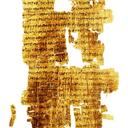
New light on the Narcissus myth: P.Oxy. LXIX 4711One of the most interesting of the new literary fragments published in Volume LXIX of The Oxyrhynchus Papyri is a set of brief mythological narratives in Greek elegiac couplets. The subjects are Narcissus, Adonis, and Asteria (the nymph who became the island of Delos). Each of the three fragmentary narratives features metamorphosis prominently, and the editor, W.B. Henry, has suggested that the fragment may belong to the Metamorphoses by Parthenius of Nicaea. G.O. Hutchinson, ‘The Metamorphosis of Metamorphosis: P. Oxy. 4711 and Ovid’, Zeitschrift für Papyrologie und Epigraphik 155 (2006), 71–84, considers the attribution plausible. Of particular interest is the poet’s treatment of the Narcissus story, poetic accounts of which are very rare. The myth is first attested around the turn of the first century AD. It turns up famously in Ovid’s Latin epic, the Metamorphoses (3.339–510). There is also a less well-known Greek account in a collection of stories in prose (Διηγήσεις) composed by one Conon about the same time, and preserved in epitome form. If our version is by Parthenius, it has a special importance. Parthenius came to Rome after being captured in the third Mithridatic War, perhaps in 73 BC. He was a very influential figure among the poets of the time, and Ovid would almost certainly have read his account of the myth before composing his own. Here are a reconstructed text and English translation of the fragment; for images of the papyrus, click here. The order of the two sides (↓, with the papyrus fibres running vertically, and →, with the papyrus fibres running horizontally) is not known. Conjectural supplements are enclosed in square brackets in the Greek; `´ indicates an addition above the line, † a corrupt word. Dots indicate uncertainly read or (in gaps) missing letters. ↓
(ADONIS concluded) ... laughter-loving1 ... (ASTERIA) Daughter of Coeus and Phoebe the Titaness, →
(NARCISSUS) ... god-like ... The new version of the Narcissus story is much more concise than Ovid’s. Ovid devotes many verses to the nymph Echo, who in her unrequited love for Narcissus wastes away until only an echo remains: she can only repeat what others say. There is no trace of her either in the papyrus text or in Conon’s account. There, Narcissus is a young boy and his lovers are all male. Ovid also distinguishes himself from the other two authors by having Narcissus, like Echo, simply waste away. His body mysteriously disappears, and when the nymphs come to collect it, they find the flower in its place. In Conon’s version, as in the new papyrus, the boy kills himself. It is his blood that produces the narcissus flower. (In this respect, the story resembles that of Adonis, told on the other side of the papyrus fragment.) In the light of the new evidence, it seems that Ovid may well have been the first to give the myth its now familiar form. |
|||